And we are on our way again, winding our way out of the hills and down to Naracoorte.
The trip to Naracoorte was supposed to be a leisurely drive with the opportunity to stop occasionally as we went, however after a later than desired start and a fanatical hunt for hot chips that were apparently only able to come from shop with a particular looking storefront the leisurely was removed.
We had already organised to stay at the showgrounds when we arrived and this turned out to be a great move as it was a lovely place to stay and very central to the town, meaning that the bikes got unloaded again. Interestingly, we stayed for four nights without anybody else around even though there was about 24 sites available.
The local visitor centre incorporates a fantastic little museum centred around a history of the Australian wool industry. Relocated around this are an 1800’s woolshed, a small town post office and an old schoolhouse – all set up with original equipment.
Not far out of town are a set of limestone caves, made famous due to the discovery of large scale fossils dating from around 500,000 years ago through the present. The importance of these was demonstrated through the presence of a colleague of David Attenborough’s, along with film crew, while we were there. The interpretive centre that has been built adjoining the caves is a fantastic source of information and the displays of important but extinct parts of our fauna appealed to young and old alike.
After looking at all the available cave tours we decided on the fossil tour, which turned out to be a great decision. Liz and I learnt things about Australia’s animal history that we had never heard of before and the walk through the caves itself was also a valuable and interesting experience.
Sadly Liz wasn’t well for the last day we were in Naracoorte which put paid to our plans to wander through the Coonawarra region and down to Mt Gambier. It did however result in me being able to say that I had visited the Clare Valley, Adelaide Hills, Barossa and Coonawarra without stepping foot into a winery – although I’m not sure I see that as being that much of a positive. For the first time on this trip we were also on something of a timetable which meant we couldn’t spend the extra day needed as Max was due to do his NAPLAN testing in the coming week and Liz had organised for him to do it at the North Hamilton Primary School, therefore it was off to the Hamilton area. I say area as we hadn’t actually yet fixed on where we were staying, but I am sure we will sort that out by the time we arrive!
Sunday, 8 May 2011

Sunday, 1 May 2011
Hahndorf
The Adelaide Hills are certainly the most picturesque place we have stayed up until now, although some of the rugged beauty we have already passed through rivals it as far as the spectacular goes. One of the outcomes of staying in the Hills was the fact that once again we were without Telstra coverage, something we certainly didn’t expect since we were only 25 km’s from the centre of Adelaide, but underlines the difference between measuring the coverage as a percentage of the population versus a percentage of the country.
Cudlee Creek Caravan Park turned out to be right on the creek itself, which was a decent sized body of water. It had enormous potential, however isn’t yet taking full advantage of this. Cudlee Creek as a place is different from the perspective that it appears to consist of the caravan park and a co-located tavern, a wildlife park, a cafe and a church – spread out along about 3km’s of road, so there is never any certainty about when you have actually arrive at Cudlee Creek itself.
The caravan park had a large grassed recreation area, plenty of mature trees and a lot of room, but looked somewhat run-down – with the ablutions block being in need of significant work and a number of dilapidated and unused building around. Part of the park also obviously used to be tennis courts, with some of the bitumen still in place and one of the fences remaining, which provided a strange barrier across the middle of the park. It does appear however that the new owners are making an effort to improve the park over time. Personally, the park felt a little like being in Manjimup, with a quite beautiful forest surrounding, but a pervading feeling of dampness ever present.
The first trip we made after spending the afternoon at the Toy Factory was to Hahndorf. I had often heard how beautiful/interesting Hahndorf was but didn’t have any real preconceptions on exactly what to expect. Hahndorf turned out to be a mixture of Dunsborough/Margaret River/Subiaco, but better than all of them. On the way to Hahndorf we visited Melba’s Chocolate Factory in Woodside. This was a fantastic little business which was set out in a very inviting manner. As we had actually got going fairly early in the morning (not one of our normal strengths) we arrived right on opening time, which was a little unfortunate as the kids didn’t see a significant amount of activity in the production areas, but as we were visiting just after Easter this was more than made up for in the kids minds (and Liz’s I think) by the fact that all the left-over Easter stock was half price. This resulted in us walking out with significantly more packets than we had intended. Next door to Melba’s was Woodside Cheese Wrights which was much more up my alley. The lady running it was exceptionally generous with her tastings and in the end we bought more than we probably should have, but part of it was based on the fact that we thought she should at least recoup the value of the full morning tea she had provided to the kids by way of the tastings. This was also the first time I had enjoyed goat’s cheese which proves rather than not liking goat’s cheese itself, I had obviously just not tried decent cheese before. As we walked out Max decided that while Melba’s had been a good place to visit he had enjoyed the Cheese Wrights far more.
Next on the list was Beerenberg’s, which was the other side of Hahndorf. There were lots of things that were very inviting, but unlike the other too places the we didn’t get a feeling of value for money from the experience as a whole. In the end we left with just a tiny jar of Hot English Mustard as the kid’s were still sure they liked it and I didn’t see the point in buying anything too big. Interestingly, they did like the mustard and I have had to invest in a much larger jar as I am now sharing it.
From here we headed back into Hahndorf itself for lunch. As we had everything we needed with us except for bread Liz jumped out when we saw a bakery and arrived back with some beautiful, heavy German style rolls (apt as Hahndorf still trades heavily on it’s status as Australia’s first German settlement). We found a little park near the centre of town and then proceeded to eat in the car as the rain set in. After lunch however the rain lightened up and we were able to spend a very pleasant couple of hours wandering around.
Cudlee Creek Caravan Park turned out to be right on the creek itself, which was a decent sized body of water. It had enormous potential, however isn’t yet taking full advantage of this. Cudlee Creek as a place is different from the perspective that it appears to consist of the caravan park and a co-located tavern, a wildlife park, a cafe and a church – spread out along about 3km’s of road, so there is never any certainty about when you have actually arrive at Cudlee Creek itself.
The caravan park had a large grassed recreation area, plenty of mature trees and a lot of room, but looked somewhat run-down – with the ablutions block being in need of significant work and a number of dilapidated and unused building around. Part of the park also obviously used to be tennis courts, with some of the bitumen still in place and one of the fences remaining, which provided a strange barrier across the middle of the park. It does appear however that the new owners are making an effort to improve the park over time. Personally, the park felt a little like being in Manjimup, with a quite beautiful forest surrounding, but a pervading feeling of dampness ever present.
The first trip we made after spending the afternoon at the Toy Factory was to Hahndorf. I had often heard how beautiful/interesting Hahndorf was but didn’t have any real preconceptions on exactly what to expect. Hahndorf turned out to be a mixture of Dunsborough/Margaret River/Subiaco, but better than all of them. On the way to Hahndorf we visited Melba’s Chocolate Factory in Woodside. This was a fantastic little business which was set out in a very inviting manner. As we had actually got going fairly early in the morning (not one of our normal strengths) we arrived right on opening time, which was a little unfortunate as the kids didn’t see a significant amount of activity in the production areas, but as we were visiting just after Easter this was more than made up for in the kids minds (and Liz’s I think) by the fact that all the left-over Easter stock was half price. This resulted in us walking out with significantly more packets than we had intended. Next door to Melba’s was Woodside Cheese Wrights which was much more up my alley. The lady running it was exceptionally generous with her tastings and in the end we bought more than we probably should have, but part of it was based on the fact that we thought she should at least recoup the value of the full morning tea she had provided to the kids by way of the tastings. This was also the first time I had enjoyed goat’s cheese which proves rather than not liking goat’s cheese itself, I had obviously just not tried decent cheese before. As we walked out Max decided that while Melba’s had been a good place to visit he had enjoyed the Cheese Wrights far more.
Next on the list was Beerenberg’s, which was the other side of Hahndorf. There were lots of things that were very inviting, but unlike the other too places the we didn’t get a feeling of value for money from the experience as a whole. In the end we left with just a tiny jar of Hot English Mustard as the kid’s were still sure they liked it and I didn’t see the point in buying anything too big. Interestingly, they did like the mustard and I have had to invest in a much larger jar as I am now sharing it.
From here we headed back into Hahndorf itself for lunch. As we had everything we needed with us except for bread Liz jumped out when we saw a bakery and arrived back with some beautiful, heavy German style rolls (apt as Hahndorf still trades heavily on it’s status as Australia’s first German settlement). We found a little park near the centre of town and then proceeded to eat in the car as the rain set in. After lunch however the rain lightened up and we were able to spend a very pleasant couple of hours wandering around.
Friday, 29 April 2011
From Yacka to Cudlee Creek
 Easter Friday was supposed to include and ecumenical service in the park adjacent to where we were camped. However, the day turned out to be one of the few wet ones we have had since we set off, with the service moved the the Yacka Institute building (the town hall).
On arriving I found it was being taken by the local area Anglican priest – Gunnar Ripon – who had retired there from home. He had previously been the Dean of the Bunbury Cathedral and was now back working full time due to the absence of anyone else in the area. Even more unexpected was finding that the service had actually been put together by the Bunbury Parish!
The town hall is a lovely old building, in very good condition.
On Saturday we decided to follow the Yacka Historic Trail, a walk around the town. One of the other campers had commented the day before that it seemed to cover nearly every building in Yacka
 .
. The walk itself was very interesting, although the highlight for the kids seemed to be stopping at the craft shop mid-tour for an icecream (the craft shop is the only shop still open in town). Some of the building are absolutely beautiful, with Yacka’s heyday seeming to be the late 1800’s and early 1900’s. It was interesting to see that the town had been of a size to justify a Holden dealership at one stage, a far cry from today.
While talking to Mrs Tilbrook at the craft shop we found out that he archives were going to be open on the Sunday (Mrs Tilbrook was almost an archive in herself, with the Tilbrook’s having opened up the local blacksmith’s in the early days and her and her husband still occupying the original family home in the main street).
Following the obligatory Easter egg hunt we ventured up to the archives on the Sunday afternoon. It turned out that Mrs Tilbrook had set up some special displays for the kids on the off chance we did visit. Included in that was one of the original day books from the blacksmith’s, which showed how versatile it had been in the early days. Not only did they construct coffins when required, they also organised and carried out the funerals themselves.
The archives themselves were housed in the old bank building (which had closed in the 1990’s). The original fittings were still, for the most part, there. On top of the archival information we were also lucky enough to get a tour of the town hall. This was fantastic for Liz and the kids as they hadn’t accompanied me on the Friday, and good for me as we got to see areas that hadn’t been open on the Friday.

Easter was finished off sharing a giant Easter egg with our neighbours of the past few day Marion and Wayne, who had almost become temporary grandparents to the kids. Wayne and Marion are also travelling around Australia, but starting in the East and there travels can be found at http://www.cruising2.blogspot.com/.
 |
| Wayne and Marion with Max, Harry and two friends Harry made from Adelaide, Callum and Ronan |
 Anzac Day as a little surreal, as Yacka has a war memorial, with over 40 men joining up in the First World War and almost a third of them not returning, however turned out to not have a service. This would be the first year for as long as I can remember that I wouldn’t attend an ANZAC service.
Tuesday and we ventured off to the town of Burra. Burra was the most significant of the South Australian towns in its formative years. Apparently it had around 6000 residents a thte time Adelaide consisted of only about 1000 due to copper being discovered in the area. This discovery also saved South Australia from bankruptcy at that time and several of the early community leaders were very important in the early days of South Australia. Both South Australia, with two of the early South Australian premiers coming form Burra. One went on to become the first speaker of the National parliament. The other was by the very auspicious name of Sir Henry Ayers.
 |
| The original Burra minesite |

 The only cost of this is the request of a donation to assist with the upkeep of the hall. A large amount of historical information is also contained within the hall and i think it ended up being the highlight of our visit.
  The biggest two disappointments were the unavailability of access to the fossil of the giant wombat (the Diprotodon) discovered in the area. At 120kg and being a predator I think it would have been quiet fearsome in its day. The remains are now on display in the Council offices, however being a public holiday the offices were closed. Also, we decided to finish our visit at the local bakery, only to find that it had closed at 3pm, again due to the holiday.
All in all we found Burra to be a fascinating place and well set up for tourists, but a trifle disappointing due to a reasonable number of the places of interest being unavailable due to the holiday. This appeared to be counter-productive given that there was a large number of people wandering around and lots of travellers stopping on there way home from holidays. It was still worth the visit though.
Following the visit to Burra it was time to move on. Yacka had provided a beautiful Easter location and we had ended up basing ourselves there for longer than we originally anticipated. By the time we left we had had a couple of discussions about what could be done in the town to add some activity and better take advantage of the current facilities (not enough to make us seriously stop our travelling however). It appeared to be a place with a number of opportunities, but lacking in a couple of people with the motivation to take them by the throat and squeeze more benefits out for the town as a whole. The caravan park was a prime example, with the location being magnificent, the facilities and price attracting people who were interested in getting away from the major population centres and not being too demanding, but still being a very enjoyable site to spend a few days. There was however very little opportunity for the town to capitalize ant further on the visitors attracted to the town. An opportunity to provide some basic services to these visitors by way of simple food stuffs (bread, mild etc.) or a coffee shop given the number of people that also stopped off their as a break on their way further afield appears to be just sitting there.
 |
| At the Yacka campsite |

 Cudlee Creek turned out to be not far from Gumeracha, one place in SA that I had stayed before - with the O’Dea’s in the early 90’s when I had come across to visit for Easter while working in Melbourne. The day after arriving we trekked up to Gumeracha and visited The Toy Factory, which is the site of the world’s largest rocking horse. Initially we had also intended to carry on and also go through the National Motor Museum in Birdwood, but we set off a little late and then stayed at The Toy Factory for a lot longer than originally anticipated. Max was just captured by the games especially things like Solitaire and Nine Man’s Morris) while Harry spent ages in the animal petting enclosures. Climbing up and down the big rocking horse also took up a good hour.
All in all The Toy Factory is very simply, but well set up, with the number of people wandering through the toy outlet and cafe suggesting a very successful business. In addition, at $2 to climb the rocking horse and $3 for a bag of feed when visiting the animal enclosures, they appeared to be doing a roaring trade when we were there.
Saturday, 23 April 2011
And We Enter the Flinders Ranges
Leaving Kimba we headed towards Iron Knob (I bet no bad jokes have ever been made about that!!). When we reached there we had to make a decision about where to next and decided on Whyalla. One of Liz’s friends, Nikki, has a brother there and we thought that was as good a reason for picking a destination as any.
Initially we had intended on pitching up at one of the free campsites for a few days and exploring from there, however after much froing and toing we ended up heading into the Whyalla Foreshore Caravan Park, admittedly it was just on dark when we finally organised ourselves.
We had had a couple of issues with the bikes on our way around town. Even though the bike rack was supposed to be made to carry four bikes, between the weight of the bikes, the length of the trip and the roughness of some of the roads, the rack had been slowly bending backwards. The problem was that I only noticed it when I looked in the rear view mirror as I turned a corner and noticed that the bikes didn’t swing back around with the car. I pulled over and had a look and found Harry’s bike hung up on the Jerry Cans on the caravan. While this wasn’t too hard to fix up I later found that it had severely bent his rear rim. About the same time I noticed this I also realised I had somehow left the winder behind that puts up the caravan. After much cursing and pain I finally managed to get the ‘van up through the use of a pipe wrench and jemmy bar (by this stage well and truly in the dark).
The loss of the winder changed our plans for the next few days significantly. We wandered into town the next morning to find that the closest place that we could pick up a replacement winder was Port Pirie (much to Max’s happiness given he had been wanting to visit port Pirie for a couple of days for some reason). We therefore organised to pick one up late that afternoon to make sure we at least had time to visit the Whyalla Maritime Museum.
The maritime museum is a fantastic facility, with the former Navy Frigate, The Whyalla, the centrepiece. The story of the effort that went into moving the ship across land to its present site was worth the visit alone. Harry was also very taken with the model railway depicting the mining operations at Iron Knob through to Port at Whyalla. as he said, whoever had put together the railway had ‘worked very hard’. This visit proved to me both the benefits of the continuing efforts in Bunbury to get a museum and the importance of ensuring that it is well-sited, has a mixture of physical and interactive attractions and is properly resourced, both when first constructed and on an ongoing basis.
Following this we took off for Port Pirie, arriving with about half an hour to spare. Winder in hand we then had to decide where to stay. We had initially (again) been intending to lay up in a free site for a few days, however Liz came across a small caravan site in a town called Yacka while we were trying to find the shop we were chasing in Port Pirie. After a quick discussion we decided it was worth another 70 odd k’s and set off once more (following a quick phone call to ensure there was space available.
When we got there we found that Yacka is a town of one shop, a jointly owned craft outlet that also sells a few staples such as bread. Other than that it has a few former shops, which are now for the most part used as houses (including the old pub, post office etc.). The caravan park is also something of a joint effort, with a lady on a nearby farm taking the phone calls and two of the people in town providing keys and taking money. We drove in and at once decided it looked perfect for Easter, meaning that we are likely to have our first real base since we left.
The following day we used the location to visit Clare. Much of the day was spent in the Clare library, me studying, Max reading and Liz working on her blog and doing some reading. While there Liz also set up a blog site for Harry as he wanted his grandparents to be able to also see what he had been doing while on the trip, so now every member of the family is the proud owner of a blog. Given it is the Thursday before Easter, Clare also provided the perfect opportunity to make sure we had everything we needed for the next few days with most things closed until after ANZAC Day.
Clare is one of those towns that just has a lovely feel about it. The incorporation of its historical buildings into current everyday use works exceptionally well (at face value at any rate) and the library itself was possibly the friendliest, most welcoming I have ever been in. Interestingly, it was also located within one of the historic building, rather than a purpose built facility with all the bells and whistles, but it attracted an amazing number of kids who all obviously just loved being in there.
When we got back to Yacka that night we were astounded to find no-one else camping there, even though we are in the midst of the Easter period. So, over two nights there has been one other berth occupied (and that only for the night – by a couple breaking the trip back to Adelaide after spending a week right in the Flinders Ranges). I guess it is one of those well kept secrets – $15 a night for the whole family, power, toilets and showers, lovely large area to set up in with a great children’s playground adjacent. The only thing missing is the ability to link water to the van, but it is only a short walk to pick up a bucket if needed which isn’t really an issue.
The change in scenery has also been significant as we moved from the SA outback to the Clare Valley in the space of the one day. We are now only a short drive from some of Australia’s oldest vineyards!
Initially we had intended on pitching up at one of the free campsites for a few days and exploring from there, however after much froing and toing we ended up heading into the Whyalla Foreshore Caravan Park, admittedly it was just on dark when we finally organised ourselves.
We had had a couple of issues with the bikes on our way around town. Even though the bike rack was supposed to be made to carry four bikes, between the weight of the bikes, the length of the trip and the roughness of some of the roads, the rack had been slowly bending backwards. The problem was that I only noticed it when I looked in the rear view mirror as I turned a corner and noticed that the bikes didn’t swing back around with the car. I pulled over and had a look and found Harry’s bike hung up on the Jerry Cans on the caravan. While this wasn’t too hard to fix up I later found that it had severely bent his rear rim. About the same time I noticed this I also realised I had somehow left the winder behind that puts up the caravan. After much cursing and pain I finally managed to get the ‘van up through the use of a pipe wrench and jemmy bar (by this stage well and truly in the dark).
The loss of the winder changed our plans for the next few days significantly. We wandered into town the next morning to find that the closest place that we could pick up a replacement winder was Port Pirie (much to Max’s happiness given he had been wanting to visit port Pirie for a couple of days for some reason). We therefore organised to pick one up late that afternoon to make sure we at least had time to visit the Whyalla Maritime Museum.
 |
| The "Whyalla" in its final resting place |
 |
| Harry charting a course |
 |
| At the officers dining table |
The maritime museum is a fantastic facility, with the former Navy Frigate, The Whyalla, the centrepiece. The story of the effort that went into moving the ship across land to its present site was worth the visit alone. Harry was also very taken with the model railway depicting the mining operations at Iron Knob through to Port at Whyalla. as he said, whoever had put together the railway had ‘worked very hard’. This visit proved to me both the benefits of the continuing efforts in Bunbury to get a museum and the importance of ensuring that it is well-sited, has a mixture of physical and interactive attractions and is properly resourced, both when first constructed and on an ongoing basis.
Following this we took off for Port Pirie, arriving with about half an hour to spare. Winder in hand we then had to decide where to stay. We had initially (again) been intending to lay up in a free site for a few days, however Liz came across a small caravan site in a town called Yacka while we were trying to find the shop we were chasing in Port Pirie. After a quick discussion we decided it was worth another 70 odd k’s and set off once more (following a quick phone call to ensure there was space available.
When we got there we found that Yacka is a town of one shop, a jointly owned craft outlet that also sells a few staples such as bread. Other than that it has a few former shops, which are now for the most part used as houses (including the old pub, post office etc.). The caravan park is also something of a joint effort, with a lady on a nearby farm taking the phone calls and two of the people in town providing keys and taking money. We drove in and at once decided it looked perfect for Easter, meaning that we are likely to have our first real base since we left.
 |
| Working on Max's blog in bed in the 'van |
Clare is one of those towns that just has a lovely feel about it. The incorporation of its historical buildings into current everyday use works exceptionally well (at face value at any rate) and the library itself was possibly the friendliest, most welcoming I have ever been in. Interestingly, it was also located within one of the historic building, rather than a purpose built facility with all the bells and whistles, but it attracted an amazing number of kids who all obviously just loved being in there.
When we got back to Yacka that night we were astounded to find no-one else camping there, even though we are in the midst of the Easter period. So, over two nights there has been one other berth occupied (and that only for the night – by a couple breaking the trip back to Adelaide after spending a week right in the Flinders Ranges). I guess it is one of those well kept secrets – $15 a night for the whole family, power, toilets and showers, lovely large area to set up in with a great children’s playground adjacent. The only thing missing is the ability to link water to the van, but it is only a short walk to pick up a bucket if needed which isn’t really an issue.
 |
| Yackamoorundie Park, Yacka |
Tuesday, 19 April 2011
Eyre Peninsula
As we left Eucla we made a snap decision to visit a little place called Fowlers Bay that for the next two nights. This lead to a longer day than we had originally planned on, with our first night time arrival. Although we new nothing of Fowlers Bay there was something about its name and positioning that really attracted Liz. From Fowlers Bay we travelled onto Streaky Bays for another 2 nights, much of which I wasted as I had to complete an assignment as part of the Sustainability unit I am currently undertaking. The next three nights were spent in Baird Bay before we moved onto Wudinna and Kimba for a night each.
Until we reached Wudinna all communities fishing focussed.
The bakery produced beautiful goods, including the first Cornish pastie I had had in years. The caravan park was comfortable, however half of it was very rigid in set-up – almost the caravan park version of cookie cutter style suburbia. While many people seemed to really like this layout, it lacked a little soul for my liking. The other half of the park to the area we were staying is had a much nicer feel about it, with trees dotted around and the bays designed around them.
I spent one day there in the Community School library, writing an assignment, a waste of a beautiful day but necessary. I found the dichotomy between travelling the country in a big diesel while writing about sustainability to be interesting. The library offered a free wi-fi service which was fantastic, allowing up to 105MB of download daily. I found out when I entered that this system was actually South Australia wide and the password they set me up with would apply in any library in SA, which I think is a wonderful initiative after having been involved in setting up a free wi-fi service through Bunbury just before we set off.
We left Streaky Bay the next morning with a vague intention to reach Baird Bay that night – although we were quite prepared to change our plans if we came across something that appealed, or if on arriving at Baird bay we decided it wasn’t actually what we were looking for.
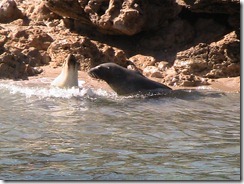 Baird Bay turned out to be a tiny fishing village, with no significant facilities apart from a small camping area – $10 a night charge, on an honesty basis – with toilets and water provided and a beautiful outlook over the bay. Sadly from an ED perspective, there was no obvious opportunity or effort for the village to capture any expenditure from visitors past the camping fees as there was nothing else on offer. A large part of the rest of the town appeared to be made up of rental and holiday homes – mainly catering to people looking for a weekend/week away fishing – again though none of this expenditure had any way of being kept in the town. A lot of this is probably due to the town being too small to justify any shopping or similar services, however there was one opportunity for an enterprising local to make an income that was being taken advantage of. Ocean Eco adventures is a business taking people out to swim with Sea Lions and Dolphins. It was through hearing about this that we first heard of Baird Bay. As we moved through the previous towns it was mentioned regularly, however when we first got to Baird Bay we couldn’t find anything about it at all. Luckily on the afternoon of our second day there Liz found a small A-frame sign out and we booked in for the following day. This was a fantastic little trip and definitely the highlight of the trip so far. Max especially just loved it and spent hours in the water with sea lions frolicking around him and nuzzling his hand.I was discussing the lack of advertising etc within the Bay itself and the owners were talking about the difficulties they experienced with promoting the business. Apparently the local council is not particularly helpful and has gone through periods of trying to get them tom close down, even though they have been operating since 1992! This attitude is almost the reverse of the key to local economic development within small communities that I have come to believe in – supporting the most entrepreneurial and successful locals as everyone else will also benefit from there successes. This was particularly apparent from this experience, with the eco tours obviously assisting other property owners to also attract visitors. In addition, nearby Port Kenny also managed to benefit from our stay as that was the closest point at which we could fill up with fuel, purchase a few necessary groceries and we also picked up a pizza for one night’s dinner. We also visited the Tahlia Caves and Venus Bay while there and really enjoyed the few days there.

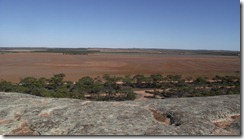 Pildappa Rock is a fantastic experience, best described as a mix between Wave Rock and a small Ayers Rock.
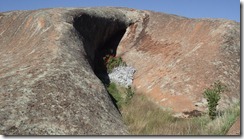
 The kids found a couple of caves on top and were having such a good time they came down, got there lunch and took it back up so that they could continue on as cavemen.
Wudinna was just an average country town, but again the service and experience made the difference. We booked in for the night and while setting up Mike Pauley turned up. Liz had heard Mike on the radio the Sunday before, being interviewed as part of a regular weekly spot while he walks from Melbourne to Fremantle raising funds and awareness fro the Arthritis Foundation. We decided to have dinner that night in the caravan park restaurant (again due to a lack of food and the fact that we had lobbed into town on a Sunday) and Mike was in there so he joined us for the first part of the meal as he finished off with a drink. He sat and talked to the kids for the most part and they seemed fascinated by what he was doing and how he was managing it. Mike is also writing a weekly blog which can be found at http://thearthritisway.wordpress.com/
The service aspect at the caravan park was proven when I was talking to Peter, the owner about difficulties I was having finishing off fitting my jerrycan holders to the caravan drawbar as I hadn’t got it completed before we left and found I was short a couple of tools once we were underway. armed with a power drill etc of Peter’s the job only took half an hour and freed up a lot of space in other parts of the van.
While standing on top of Pildappa Rock, Kimba was suggested to us as a great place to stop. We decided to head on down and have a look. Even though we arrived fairly early and hadn’t travelled very far that day it was too good a spot not to stop. A free van stop has been set up close the centre of the town as a joint venture between the local Apex and Lions clubs. It includes a good sized children’s playground, toilets, barbecue facilities, a couple of lovely pagoda style shelters and a very pleasant aspect. While there the kids and I rode into town to buy a few things and really enjoyed the feel of the town. If it wasn’t for the amount of time we had already spent in the area we would probably have stayed another night, but it is time we headed for Whyalla or Port Augusta (we haven;t decided yet, but I am sure we will sort it before tonight!
Until we reached Wudinna all communities fishing focussed.
 |
| Old Telegraph Station - Fowlers Bay |
Fowlers Bay is a community of only about 100 people. It provides limited kiosk facilities and a caravan park, with no other real services. What was really interesting was discovering the old telegraph station, unlike Eucla this one is still being used – these days as a house. Some interpretive signage outside explained that Fowlers Bay had been set up as the station prior to Eucla and then also used as the depot for the construction of the Eucla Station, so we were able to show the kids two structures, built for the same purpose at virtually the same times, one in ruins and one still being used.
Fowlers Bay appears to attract predominantly fairly hard core campers – most people were set-up for off-road, out of the way camping. Some very big set-ups were apparent – one guy with 340 kw of solar in order to power two freezers and an upright fridge freezer was indicative of many of them. We spent a couple of days there and the efforts of the new caravan park and kiosk owners was interesting. They are attempting to increase the limited offerings within the town site, building a small shop area to take over from the existing kiosk, however the major question mark from my perspective is how necessary this will prove to be with most visitors coming fully equipped through the existing expectation that nothing will be available.
Streaky Bay is a decent sized country town, with lovely friendly service in the shops I visited. Mitre 10 provided real local service, loading elderly peoples cars etc, very different from the experience we have become used to at Bunnings!The bakery produced beautiful goods, including the first Cornish pastie I had had in years. The caravan park was comfortable, however half of it was very rigid in set-up – almost the caravan park version of cookie cutter style suburbia. While many people seemed to really like this layout, it lacked a little soul for my liking. The other half of the park to the area we were staying is had a much nicer feel about it, with trees dotted around and the bays designed around them.
I spent one day there in the Community School library, writing an assignment, a waste of a beautiful day but necessary. I found the dichotomy between travelling the country in a big diesel while writing about sustainability to be interesting. The library offered a free wi-fi service which was fantastic, allowing up to 105MB of download daily. I found out when I entered that this system was actually South Australia wide and the password they set me up with would apply in any library in SA, which I think is a wonderful initiative after having been involved in setting up a free wi-fi service through Bunbury just before we set off.
We left Streaky Bay the next morning with a vague intention to reach Baird Bay that night – although we were quite prepared to change our plans if we came across something that appealed, or if on arriving at Baird bay we decided it wasn’t actually what we were looking for.
 |
| Baird Bay Campsite and outlook over town and bay |
 |
| Ocean Eco Experiences |
 Baird Bay turned out to be a tiny fishing village, with no significant facilities apart from a small camping area – $10 a night charge, on an honesty basis – with toilets and water provided and a beautiful outlook over the bay. Sadly from an ED perspective, there was no obvious opportunity or effort for the village to capture any expenditure from visitors past the camping fees as there was nothing else on offer. A large part of the rest of the town appeared to be made up of rental and holiday homes – mainly catering to people looking for a weekend/week away fishing – again though none of this expenditure had any way of being kept in the town. A lot of this is probably due to the town being too small to justify any shopping or similar services, however there was one opportunity for an enterprising local to make an income that was being taken advantage of. Ocean Eco adventures is a business taking people out to swim with Sea Lions and Dolphins. It was through hearing about this that we first heard of Baird Bay. As we moved through the previous towns it was mentioned regularly, however when we first got to Baird Bay we couldn’t find anything about it at all. Luckily on the afternoon of our second day there Liz found a small A-frame sign out and we booked in for the following day. This was a fantastic little trip and definitely the highlight of the trip so far. Max especially just loved it and spent hours in the water with sea lions frolicking around him and nuzzling his hand.
While we were at Fowlers Bay a few of the people we met who were travelling in the opposite direction had suggested we visit Pildappa Rock while we were in the area. The suggestion was that we stayed for a night, burt by this stage we were short on water and food, and Liz was really missing access to power to charge up her laptop, so we ended up moving on to Wudinna for the night. 
 Pildappa Rock is a fantastic experience, best described as a mix between Wave Rock and a small Ayers Rock.

 The kids found a couple of caves on top and were having such a good time they came down, got there lunch and took it back up so that they could continue on as cavemen.
 |
| Mike with Max and Harry |
The service aspect at the caravan park was proven when I was talking to Peter, the owner about difficulties I was having finishing off fitting my jerrycan holders to the caravan drawbar as I hadn’t got it completed before we left and found I was short a couple of tools once we were underway. armed with a power drill etc of Peter’s the job only took half an hour and freed up a lot of space in other parts of the van.
 |
| Max studying (drafting his blog) at Kimba |


Tuesday, 12 April 2011
Crossing the Nullabor
Leaving Esperance, we set off for Norseman – through places such as Salmon Gums and Grass Patch – names that were completely foreign to the rest of the family but had all been home to people I went through Muresk with.


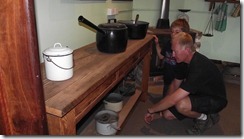 We headed off next morning (once we had finally corralled the boys) and made it to Domblegabby campsite that night, stopping at Balladonia on the way. This gave the kids the opportunity to learn a little about Skylab, as well as some assorted early camping equipment (kero stoves etc) that was in a small museum attached to the roadhouse. The playground was also appreciated by the kids.
After Balladonia we got to a point that Max had been looking forward to for a couple of days – Australia’s longest straight stretch of road. After all the anticipation however all Max could say of it was that is was very, very boring. Luckily for us friends from home (Charles and Suzanne Jenkinson) had given us a set of game cards they had made up for travelling distances with their kids which came in very handy for the rest of the Nullabor Journey.
Domblegabby has the distinction of being one of only two overnight campsites on the way across the Nullabor that has water available to campers. This is provided through a large shelter being built that feeds into a rainwater tank. Obviously water availability is entirely dependent on rainfall, however even at this time of year we were able to use a small amount. For obvious reasons this was also probably the most popular campsite we saw on the way across.
We trekked on from here to Cocklebiddy and then diverted down to the lookout that sits at the entrance to the old Eyre Telegraph Station – now used as a bird observatory. We started out being interested in making it all the way down to the observatory, however at the entrance to the track it a sign advised that it was preferred that people contacted the observatory prior to arriving, as it was often unmanned with occupants off observing birds. Given we would have had to unhitch the van and bikes in order to navigate the final 9.5 k’s, we decided against going all the way on – as did several other people we met on the way in and out! This was a clear example of some simple changes potential having a large ED impact. The sign advising that we needed to call ahead provided a phone number, however no phone coverage was available. If clear information had been available down the road in areas that had phone coverage it is likely that we would have rung ahead, as would several other of the people we met along the access way. The first real information we came across, other than a notation on the Camps Australia book we were using as our major set of maps, however was on the sign at the head of the entry road.
 As we left we made a couple of snap decisions to try to book into parks in Fowlers Bay and Streaky Bay for the next few nights. Both of these calls were successful, which meant that we had to push on from Eucla as Fowlers Bay was a fair way further than we had originally intended to drive that day – especially given that Max and I were very interested in making sure we had plenty of opportunities to look out over the cliffs

Grass Patch was the only place on this day of the trip that caused us to stop, and this was due to the entry statement. The work that had gone into these was fantastic anb the photo doesn’t really do it justice. On up the road we stopped to top the tanks off at Norseman, figuring it was the last chance to buy fuel as ‘reasonable’ prices. While there Harry was very taken with corrugated iron sculptures of camels, which gave us an  opportunity to discuss the reasons for the width of the roads and the importance of camels to the more remote regions of their early development.
 opportunity to discuss the reasons for the width of the roads and the importance of camels to the more remote regions of their early development.
 That night we parked just 16 km’s outside Norseman in a very pleasant overnight camping area. Next morning the boys took off exploring on their bikes and we began to understand how important deciding to include the bikes on the trip was, as they ended up being the first items unhitched and the last packed back up every time we stopped.

 We headed off next morning (once we had finally corralled the boys) and made it to Domblegabby campsite that night, stopping at Balladonia on the way. This gave the kids the opportunity to learn a little about Skylab, as well as some assorted early camping equipment (kero stoves etc) that was in a small museum attached to the roadhouse. The playground was also appreciated by the kids.
Domblegabby has the distinction of being one of only two overnight campsites on the way across the Nullabor that has water available to campers. This is provided through a large shelter being built that feeds into a rainwater tank. Obviously water availability is entirely dependent on rainfall, however even at this time of year we were able to use a small amount. For obvious reasons this was also probably the most popular campsite we saw on the way across.
We trekked on from here to Cocklebiddy and then diverted down to the lookout that sits at the entrance to the old Eyre Telegraph Station – now used as a bird observatory. We started out being interested in making it all the way down to the observatory, however at the entrance to the track it a sign advised that it was preferred that people contacted the observatory prior to arriving, as it was often unmanned with occupants off observing birds. Given we would have had to unhitch the van and bikes in order to navigate the final 9.5 k’s, we decided against going all the way on – as did several other people we met on the way in and out! This was a clear example of some simple changes potential having a large ED impact. The sign advising that we needed to call ahead provided a phone number, however no phone coverage was available. If clear information had been available down the road in areas that had phone coverage it is likely that we would have rung ahead, as would several other of the people we met along the access way. The first real information we came across, other than a notation on the Camps Australia book we were using as our major set of maps, however was on the sign at the head of the entry road.

We pushed on from there and arrive at Eucla, where everyone was very happy to have a shower! Eucla caravan park itself was very reasonably priced, especially given the clear ocean views from the campsites and the well maintained facilities. That night I had intentions of making it down to the hotel to see if the footy was on the TV, however, given that the Eagles ended up losing the Sydney, the fact that I didn’t make it probably justy saved me a little heartache.
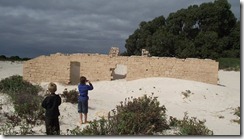
The next morning we started by trekking down to the remains of the old Eucla Telegraph Station (me in the car, the rest of the family on bikes  ). This resulted in the first puncture of the trip, happily on one of the kids bikes, not on the car or van. The telegraph station itself was well worth the visit.
). This resulted in the first puncture of the trip, happily on one of the kids bikes, not on the car or van. The telegraph station itself was well worth the visit. As we left we made a couple of snap decisions to try to book into parks in Fowlers Bay and Streaky Bay for the next few nights. Both of these calls were successful, which meant that we had to push on from Eucla as Fowlers Bay was a fair way further than we had originally intended to drive that day – especially given that Max and I were very interested in making sure we had plenty of opportunities to look out over the cliffs
of the bight.

To add to the length of the day we also decided to visit the Head of the Bight – a small development that is predominantly built around whale sightings, but which was still well worth the visit even in non-whale spotting season. While the views aren’t as spectacular as at other points, the information at the centre was interesting and the people running it  very friendly and accommodating. The only mistake we made was in stopping for lunch at the Nullabor roadhouse just prior to making our way to the Head of the Bight. When we arrived we found we could have had a mixture of fresh toasted sandwiches and home made scones for a fraction of the price of the roadhouse food.
After leaving here we made our way directly for Fowlers Bay, and arrived at our destination fro the first time in the dark! something we intend to do as little as possible as we missed seeing anything of the entry at all and then had to set up at a time we would be preferring to ready the kids for bed. It was worth it however to ensure we spent time on the bight – in retrospect we could have probably overnighted half way.
 very friendly and accommodating. The only mistake we made was in stopping for lunch at the Nullabor roadhouse just prior to making our way to the Head of the Bight. When we arrived we found we could have had a mixture of fresh toasted sandwiches and home made scones for a fraction of the price of the roadhouse food.
And we're on the road
 We set off from Balingup, following a weekend on the farm with my parents. This included a day of bowls in a team with Liz, Dad and my niece Amber, a fun day for predominantly non-bowlers that attracted 22 teams of 4 from as far afield as Eaton, once again showing the ability of Balingup to successfully put on unusual events very successfully.
 We headed for Ongerup, but only made is as far as Broomehill, after making a late decision to take the kids through the Kodja Place in Kojonup as they were too young to remember the last time they had seen it. This is a wonderful example of a small area making the most of their history and presenting it in a manner interesting to people of all ages.
We moved on from there to Ravensthorpe, however did drop into Ongerup for fuel and some groceries. It was lucky for us that we did stop too, as it turned out that the general store was run by Wes and Rachael Sawyer, who I had grown up in the same area as I had. In fact Rachael was good friends with my sister and had spent several nights staying with us over the years.
 Ravensthorpe Caravan Park, when we got there, was certainly different. The lady running it has a real dislike of Barbie Dolls and has decided to make her personal aversion into a very public display at the entrance to the park office. The kids were also very taken with the toilets being used as planter boxes.
 From Ravensthorpe we headed into Esperance, with a short stop at Munglinup, and caught up with a school friend of Liz’s. He and his family were lovely and we are already talking about heading back down there for a week or more in the next couple of years. Esperance had a really nice feel about it in general and certainly made a significant marker between travelling around rural WA and moving into genuine remote areas.
 Munglinup was interesting, as it is only a small community, with the highway now passing it by, however they have built a reasonably sized playground opposite the roadhouse, just visible from the highway, which the kids really enjoyed. Good facilities like this for the kids are under-rated when travelling long, sparsely populated roads and towns that make the effort to provide them really need to advertise them well before you arrive at them in order to give people enough time to decide to stop. Opportunities for the kids to let off some steam after sitting in the car for a couple of hours are also very welcome.
Subscribe to:
Posts (Atom)